Practical tips for architects and builders
The last few weeks have been a good reminder that New Zealand homes don’t just need to be warm and efficient in winter – they also need to stay comfortable during extended hot spells.
Homes built with SIPpro panels create a very effective thermal envelope. That’s a huge advantage for winter, but it also means you need to be deliberate about how you manage solar gain, airflow and internal heat in summer.
Here are some key design moves to keep SIP homes cool, stable and comfortable all year round.

1. Start with orientation and glazing, not the air-con
Overheating is usually designed in long before anyone talks about cooling.
- Prioritise north- facing glazing where you can control sun with eaves or shading.
- Be cautious with large east and especially west- facing glass – these are the hardest to shade.
- Consider lower solar heat gain glass on exposed elevations if views demand more glazing.
Get the sun angles and glass right first, then size the mechanical systems to support the design, not rescue it.
2. Use SIPpro’s performance - and control the sun
SIP walls and roofs dramatically slow heat moving through the envelope. In winter, that keeps heat in. In summer, that helps keep heat out – as long as you stop the sun hitting the inside surfaces.
Design for:
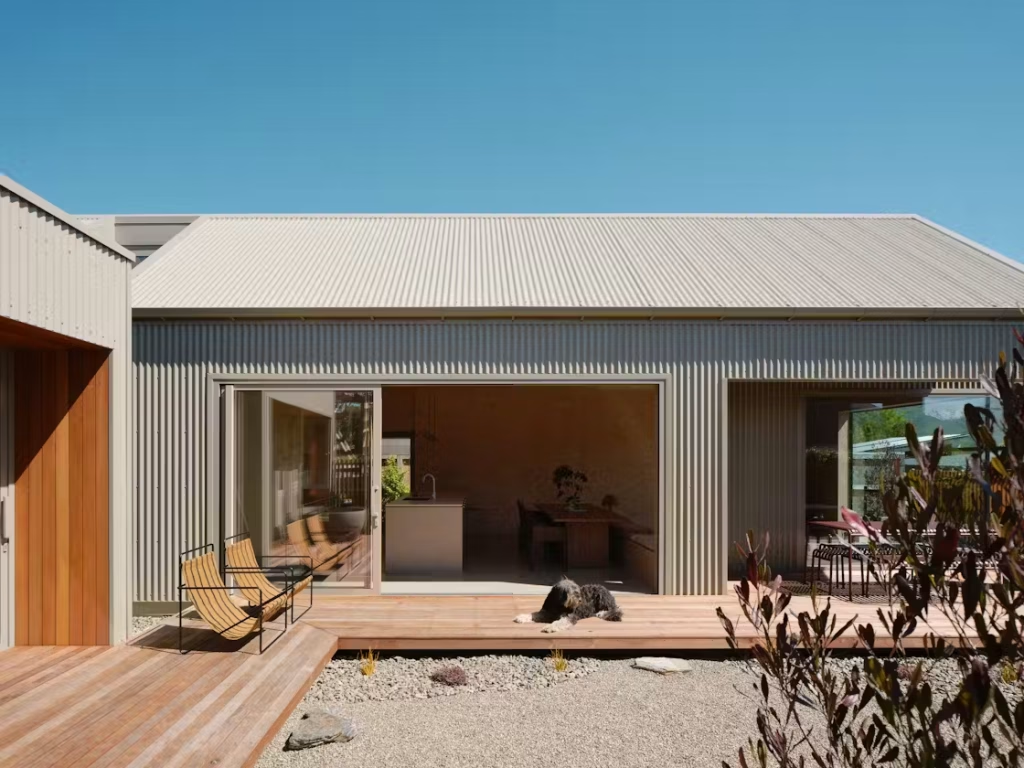
- Decent eaves and overhangs sized for high summer sun.
- Recessed openings that naturally shade glass.
- Screens, fins or pergolas on difficult elevations where eaves alone won’t cut it.
Think of SIPpro as the “thermos” and your shading strategy as the lid. Both need to work together.
3. Design proper cross- ventilation, not just “some opening windows”
In a high- performance SIP envelope, you can’t rely on accidental draughts to flush heat.
Plan ventilation like you’d plan structure:
- Put operable windows or doors on opposite sides of living spaces to create cross- breeze paths.
- Use high- level openings (clerestories, roof windows, operable skylights) so hot air has somewhere to go.
- Consider tilt- and- turn or parallel- opening windows that can be safely left on vent in summer evenings.
If you draw a plan and struggle to sketch clear airflow paths, your occupants will struggle too.
4. Pair airtight construction with smart mechanical ventilation
Homes built with SIPpro can achieve very low air change rates. That’s exactly what you want for winter efficiency, but it means you must plan how fresh air and summer heat removal will work.
Key considerations:
- Balanced mechanical ventilation (MVHR/ERV) to handle day-to-day indoor air quality.
- Summer / bypass modes to avoid unnecessary heat recovery on hot days.
- Duct layouts that support night-purge strategies, especially in upper floors and roof spaces.
The goal is simple: airtightness delivers control, and ventilation systems give you the tools to use that control properly.

5. Be intentional about roof design and colour
On hot days, the roof does a lot of the heavy lifting.
- Light-coloured roofing can significantly reduce solar gain.
- Consider warm-roof type build-ups with SIPpro roofs where appropriate, to control condensation and manage overheating.
- Detail ventilated cavities above the SIP roof where required, to shed heat before it reaches the interior.
With SIPpro roofs, you already have a highly insulated element – your job is to stop the roof cladding from becoming a giant radiator.
7. Treat shading as part of the architecture, not an afterthought
Temporary blinds and stick – on films rarely get used the way designers hope. Integrated shading performs better and looks better.
Design in:
- Deep verandas and covered decks on the most exposed sides.
- External blinds or sliding screens that can be operated from inside.
- Pergolas with adjustable slats where clients want flexibility between sun and shade.
If it’s designed as part of the building, it’s far more likely to be used.
8. Reduce internal heat gains - especially in smaller, efficient homes
In well insulated SIP homes, even small internal gains can matter.
Make room early in the design for:
- Locating fridges, ovens and hot water systems thoughtfully, away from the most sensitive spaces.
- Specifying efficient lighting and appliances as standard, not as an optional extra.
- Allowing ventilation and shading to do the heavy lifting before resorting to active cooling.
High-performance envelopes amplify both good and bad decisions. Small loads add up.
9. Coordinate details early: services, penetrations and junctions
Poorly thought-out penetrations can compromise both airtightness and summer performance.
- Agree early on service cavities vs chases vs surface ducting.
- Minimise unplanned penetrations through the SIPpro envelope, and detail the ones you do have properly.
- Use tested junction details for eaves, parapets and roof interfaces to avoid weak points.
Good detailing protects both winter efficiency and summer comfort.
10. Model it, don’t guess
For higher-performance projects, especially Passive House-inspired designs, basic rule-of-thumb is no longer enough.
Where budgets allow:
- Use energy and overheating modelling to test glazing ratios, shading, roof colour and ventilation strategies.
- Compare scenarios with and without specific design moves so you can justify decisions to clients.
SIPpro panels give you a very predictable envelope. Modelling lets you exploit that predictability rather than designing by feel.
Bringing it all together
Homes built with SIPpro already have the fundamentals for comfort: airtightness, continuous insulation and a robust structure.
When you combine that with good orientation, smart glazing, integrated shading and planned ventilation, you get homes that perform in winter and summer – not just on the day they’re signed off, but for decades.
If you’re working on a project where overheating is a concern, we’re happy to talk through panel options, roof build- ups and detailing so the “keep cool” strategy is designed in from day one, not bolted on at the end.